Cantastoriememorie · emozioni · tradizioni Torna ai racconti

Leggenda · 6 min di lettura

La strada delle lucciole

Quando la notte sembra non finire, basta seguire la piccola luce che conosce la strada del ritorno.

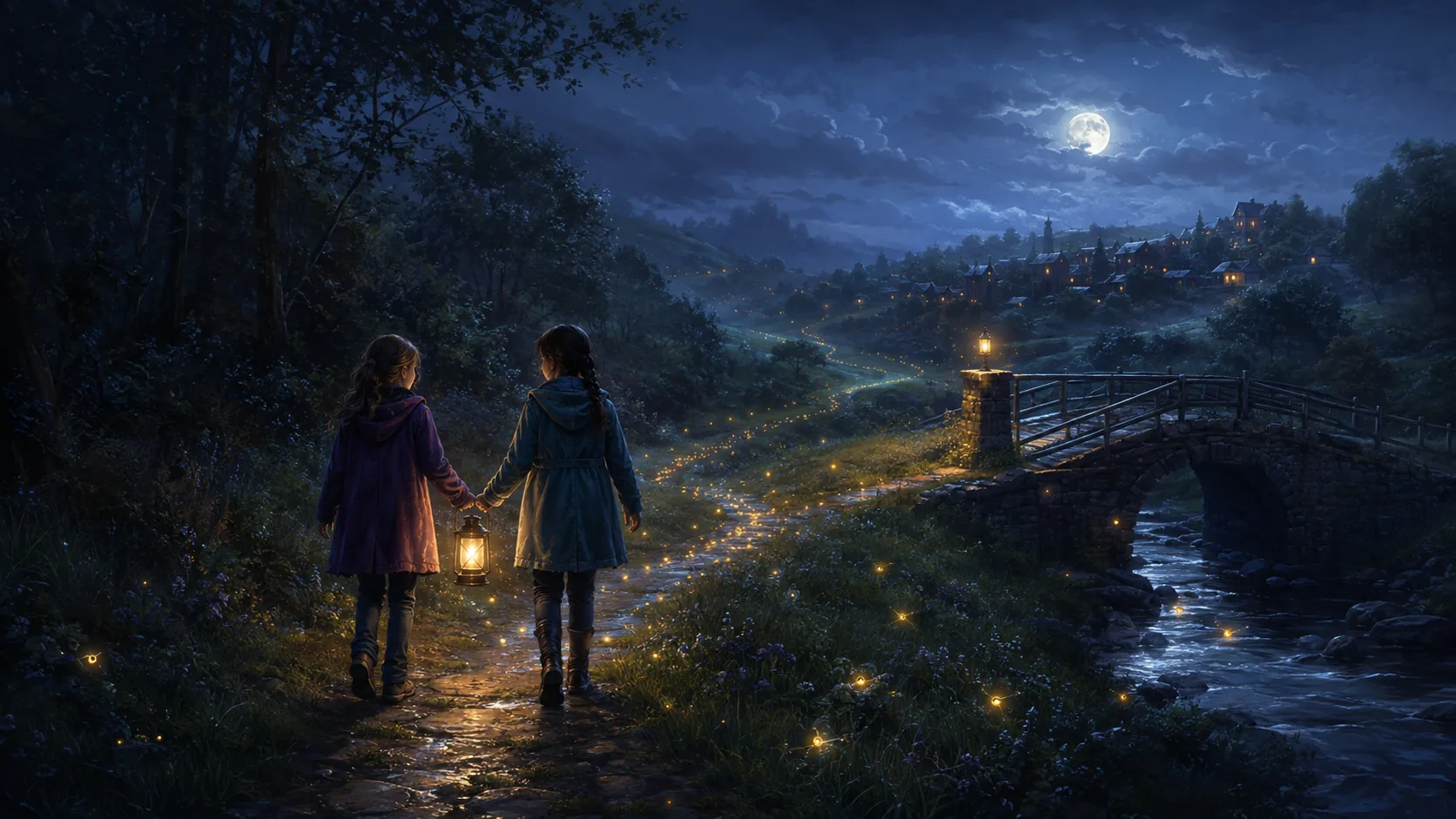
Nora e Yara seguono una scia di lucciole verso un ponte nel bosco
La notte
conosce la via

Ascolta la storia

La lettura vocale non è disponibile in questo browser

Video narrativo

La strada delle lucciole

Guarda la fiaba in formato illustrato e segui Nora e Yara lungo il sentiero di luci che conduce al vecchio ponte e alla strada del ritorno.

01

Il paese che lasciava una luce

Valleverde era un paese piccolo, stretto tra una collina e il Bosco Lungo. Di giorno sembrava un posto come tanti: case con i gerani alle finestre, una piazza con il pozzo di pietra e una strada che saliva fino alla vecchia torre. Ma quando arrivava la sera, Valleverde diventava un altro luogo.

Ogni famiglia lasciava una luce accesa vicino alla finestra. Non serviva a illuminare la stanza. Serviva a farsi trovare.

La gente diceva che, un tempo, una donna fosse tornata al paese dopo essersi persa nel bosco per tre giorni. Non aveva con sé una mappa né una lanterna. Aveva soltanto seguito un minuscolo chiarore che si muoveva tra l'erba. Da allora, nelle notti d'estate, le lucciole comparivano lungo un sentiero che nessuno riusciva a vedere di giorno.

«La strada delle lucciole non conduce a chi corre» raccontava nonna Ada. «Conduce a chi sa fermarsi, ascoltare e tenere per mano qualcuno.»

«La strada delle lucciole non conduce a chi corre. Conduce a chi sa fermarsi.»

Nora aveva ascoltato quella storia tante volte, ma non ci aveva mai creduto davvero. Aveva undici anni e da poco si era trasferita a Valleverde con suo padre. Le mancava la città, le mancava sua madre, che lavorava lontano e telefonava quando da quelle parti era già buio. Soprattutto, le mancava sapere dove mettere i pensieri quando diventavano troppo grandi.

Per questo parlava poco. Teneva al polso un filo rosso che sua madre le aveva annodato prima di partire e, quando sentiva nostalgia, lo toccava con due dita. Era il suo modo di ricordarsi che alcune persone, anche se lontane, sanno restare vicine.

02

La notte del temporale

La notte in cui tutto cominciò, Valleverde festeggiava la Festa delle Finestre Accese. I bambini correvano per la piazza con piccoli barattoli di vetro e gli adulti appendevano fili di lampadine tra i balconi. Nora era seduta sul gradino della fontana insieme a Yara, una bambina arrivata da poco nel paese.

Yara parlava ancora con esitazione la lingua di Valleverde, ma disegnava benissimo. Aveva riempito un quaderno di case, alberi e animali con occhi enormi. Nora non aveva bisogno di molte parole per capirla. Le bastava guardare i suoi disegni.

Quando il primo tuono fece tremare i vetri, le lampadine si spensero tutte insieme. La piazza sprofondò nel buio. Poi cominciò a piovere, prima piano e poi con una forza che sembrava voler lavare via le strade.

Fu allora che Yara si accorse che sua nonna, Amal, non era ancora tornata dalla collina. Era uscita prima della festa per lasciare una piccola lampada davanti al vecchio ponte, come faceva ogni anno in ricordo di chi non aveva trovato la strada di casa.

Gli adulti presero le torce e si divisero lungo la strada principale. Nonna Ada rimase con le bambine sotto il portico, ma Nora vide qualcosa oltre il cancello: una luce piccolissima, sospesa nel buio.

Una lucciola.

La luce si spostò di pochi centimetri, poi si fermò. Sembrava aspettare.

Nora strinse il filo rosso al polso. «Nonna» disse, «e se fosse quella?»

Ada la guardò a lungo. Poi prese una lanterna, la affidò a Yara e chiamò suo figlio. «Andiamo insieme. La strada può essere magica, ma nessuno deve percorrerla da solo.»

03

Il sentiero che comparve

Superato l'ultimo gruppo di case, la pioggia diminuì. Le torce degli adulti illuminavano il fango e le radici, ma la piccola luce continuava a scivolare davanti a loro. Dopo la prima ne apparve una seconda. Poi una terza. In pochi minuti, il bosco si riempì di puntini dorati.

Non formavano una linea diritta. Disegnavano curve, soste e piccoli cerchi. Ogni volta che qualcuno voleva affrettarsi, le luci si fermavano. Quando invece il gruppo rallentava per aiutare chi scivolava o per ascoltare un rumore tra gli alberi, le lucciole riprendevano il cammino.

Yara indicò un cespuglio. Dentro c'era un riccio bagnato. Suo padre lo sollevò con delicatezza e lo spostò sotto una grande foglia. Subito, altre luci si accesero vicino ai loro piedi.

«Vedi?» sussurrò nonna Ada. «La strada si illumina quando qualcuno si prende cura di qualcun altro.»

Nora non rispose. Guardava le lucciole e pensava a sua madre, alla sua voce al telefono, alle volte in cui le aveva detto: “Se non trovi la strada, fermati. Respira. La strada troverà te”. Forse non era una frase soltanto. Forse era una cosa che le madri sapevano da sempre.

Dopo una curva, il sentiero si aprì in una radura. Al centro c'era il vecchio ponte, quello che nessuno usava più perché una parte delle assi era stata portata via dall'acqua. Dall'altra parte, sotto una tettoia di pietra, tremava una piccola luce.

«Amal!» gridò Yara.

La nonna rispose. Era seduta accanto alla lampada che aveva portato dalla piazza. Non si era fatta male: il temporale aveva fatto cadere un ramo sulla strada e lei aveva preferito ripararsi, aspettando che passasse. Ma aveva paura che nessuno riuscisse a trovarla.

Quando vide le lucciole, sorrise. «Sono arrivate prima di voi» disse. «Sapevo che non mi avrebbero lasciata sola.»

04

Il ritorno

Per tornare indietro, il gruppo non attraversò il ponte. Seguì invece un passaggio stretto tra gli alberi, visibile soltanto grazie alle luci dorate. Il cammino era più lungo, ma asciutto e sicuro.

Nora camminava accanto ad Amal. La vecchia signora teneva la lampada davanti a sé e Yara le stringeva la mano. A un certo punto Nora si accorse che una lucciola si era posata sul suo filo rosso.

Non la scacciò. Rimase ferma, proprio come aveva insegnato nonna Ada. La luce tremò, si sollevò e andò a posarsi sul vetro della lanterna di Yara. Le due bambine si guardarono. Yara aprì il quaderno e, alla luce della lampada, disegnò tre puntini d'oro sopra una strada curva.

Nora sorrise. «È la strada del ritorno» disse.

Quando raggiunsero il paese, tutte le finestre erano di nuovo illuminate. Le persone correvano incontro ad Amal, ma nessuno chiese alle lucciole dove fossero state. In fondo, a Valleverde, certe cose si ringraziano lasciandole libere di andare.

La mattina dopo, del sentiero non rimaneva alcuna traccia. Il bosco era soltanto un bosco, il ponte era ancora vecchio e il fango aveva cancellato le impronte. Ma davanti alla finestra di ogni casa c'era una piccola luce accesa.

Anche davanti alla casa di Nora.

Quella sera sua madre telefonò. Nora le raccontò tutto: il temporale, Amal, il riccio, il sentiero e la lucciola che si era posata sul filo rosso.

«Allora l'hai trovata» disse sua madre.

«La strada?»

«No. La parte di te che sapeva già tornare.»

Se vuoi seguire un’altra strada guidata da ciò che non si vede, continua con Il paese che aveva smarrito il vento.

Da quella notte, ogni volta che qualcuno a Valleverde si sentiva perduto, lasciava una luce alla finestra. E, se aveva fortuna, poco prima dell'alba vedeva una lucciola attraversare il buio.

Perché la notte non è mai soltanto notte, quando c'è qualcuno disposto ad aspettarti.
English translation

The Road of Fireflies

When the night seems endless, all you need to do is follow the little light that knows the way home.

01

The village that left a light

Valleverde was a small village, squeezed between a hill and the Long Wood. By day it seemed like any other place: houses with geraniums in the windows, a square with a stone well, and a road that climbed toward the old tower. But when evening came, Valleverde became another place.

Every family left a light on near the window. It was not meant to illuminate the room. It was meant to help someone be found.

People said that, long ago, a woman had returned to the village after getting lost in the woods for three days. She had no map and no lantern. She had followed only a tiny glow moving through the grass. From then on, on summer nights, fireflies appeared along a path no one could see during the day.

“The road of fireflies does not lead to those who run,” Grandma Ada used to say. “It leads to those who know how to stop, listen, and hold someone's hand.”

Nora had heard the story many times, but she had never truly believed it. She was eleven and had recently moved to Valleverde with her father. She missed the city, and she missed her mother, who worked far away and called when it was already dark there. Above all, she missed knowing where to put her thoughts when they grew too large.

That was why she spoke little. Around her wrist she wore a red thread her mother had tied before leaving, and whenever she felt homesick, she touched it with two fingers. It was her way of remembering that some people, even when far away, know how to stay close.

The road of fireflies does not lead to those who run. It leads to those who know how to stop.
02

The night of the storm

The night everything began, Valleverde was celebrating the Festival of Lit Windows. Children ran through the square with little glass jars, and adults hung strings of bulbs between the balconies. Nora was sitting on the fountain step with Yara, a girl who had recently arrived in the village.

Yara still spoke the language of Valleverde hesitantly, but she drew beautifully. She had filled a notebook with houses, trees, and animals with enormous eyes. Nora did not need many words to understand her. She only had to look at her drawings.

When the first thunderclap made the windows tremble, all the bulbs went out at once. The square sank into darkness. Then it began to rain, first softly and then with a force that seemed to want to wash the streets away.

That was when Yara realized that her grandmother Amal had not yet returned from the hill. She had gone out before the festival to leave a small lamp in front of the old bridge, as she did every year to remember those who had not found the way home.

The adults took their flashlights and spread out along the main road. Grandma Ada stayed with the girls beneath the porch, but Nora saw something beyond the gate: a tiny light suspended in the darkness.

A firefly.

The light moved a few centimeters, then stopped. It seemed to be waiting.

Nora tightened the red thread around her wrist. “Grandma,” she said, “what if that is the one?”

Ada looked at her for a long time. Then she took a lantern, handed it to Yara, and called her son. “We will go together. The road may be magical, but no one should walk it alone.”

03

The path that appeared

Once they passed the last group of houses, the rain grew lighter. The adults' flashlights lit the mud and the roots, but the little light continued to slip ahead of them. After the first, a second appeared. Then a third. Within minutes, the woods were filled with golden dots.

They did not form a straight line. They drew curves, pauses, and small circles. Whenever someone wanted to hurry, the lights stopped. When the group slowed down to help someone who slipped or to listen to a sound among the trees, the fireflies continued on.

Yara pointed toward a bush. Inside was a wet hedgehog. Her father lifted it gently and moved it beneath a large leaf. At once, more lights came on near their feet.

“Do you see?” whispered Grandma Ada. “The road lights up when someone takes care of someone else.”

Nora did not answer. She watched the fireflies and thought of her mother, her voice on the phone, and the times she had said, “If you cannot find the road, stop. Breathe. The road will find you.” Perhaps it was not only a phrase. Perhaps it was something mothers had always known.

After a bend, the path opened into a clearing. In the center stood the old bridge, the one no one used anymore because some of its boards had been carried away by the water. On the other side, beneath a stone shelter, a small light was trembling.

“Amal!” Yara shouted.

Her grandmother answered. She was sitting beside the lamp she had brought from the square. She was not hurt: the storm had brought down a branch across the road, and she had chosen to shelter while waiting for it to pass. But she had been afraid that no one would be able to find her.

When she saw the fireflies, she smiled. “They arrived before you,” she said. “I knew they would not leave me alone.”

04

The return

To go back, the group did not cross the bridge. Instead, they followed a narrow passage between the trees, visible only because of the golden lights. The way was longer, but dry and safe.

Nora walked beside Amal. The old woman held the lamp in front of her and Yara held her hand. At one point Nora noticed that a firefly had landed on her red thread.

She did not brush it away. She stayed still, just as Grandma Ada had taught her. The light trembled, rose, and landed on the glass of Yara's lantern. The two girls looked at each other. Yara opened her notebook and, in the lantern light, drew three golden dots above a curved road.

Nora smiled. “It is the road home,” she said.

When they reached the village, every window was lit again. People ran to meet Amal, but no one asked the fireflies where they had been. In Valleverde, after all, some things are thanked by being left free to go.

The next morning, no trace of the path remained. The woods were only woods, the bridge was still old, and the mud had erased the footprints. But in front of every house there was a small light burning.

There was one in front of Nora's house too.

That evening her mother called. Nora told her everything: the storm, Amal, the hedgehog, the path, and the firefly that had landed on the red thread.

“Then you found it,” her mother said.

“The road?”

“No. The part of you that already knew how to return.”

From that night on, whenever someone in Valleverde felt lost, they left a light in the window. And, if they were lucky, just before dawn they saw a firefly cross the darkness.

Because the night is never only night when someone is willing to wait for you.

La tua impressione

Come hai trovato questa storia?

Lascia una valutazione da una a cinque stelle per aiutare altri lettori a scegliere il loro prossimo racconto.

Valuta La strada delle lucciole da una a cinque stelle

Scegli da una a cinque stelle.

La scelta viene ricordata su questo dispositivo.

Il viaggio continua

Altre storie da custodire

Scelti per te

Tre racconti vicini per tema, atmosfera e significato